
Published by HashDeploy
The Bitcoin mining industry continues to become more competitive, with publicly traded mining companies expanding at an unprecedented pace. Large-scale operators now control significant portions of the global Bitcoin network’s computing power, measured in exahashes per second (EH/s).
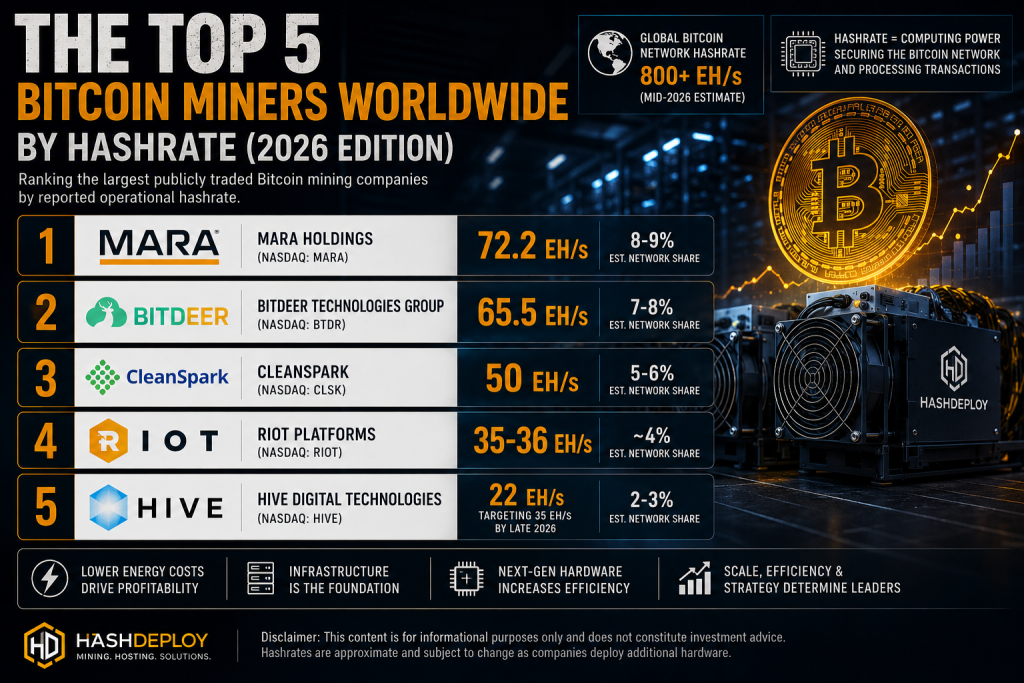
As of mid-2026, the global Bitcoin network hashrate fluctuates around the 800+ EH/s range, making mining more competitive than ever before. Below are the five largest publicly traded Bitcoin mining companies based on reported operational hashrate.¹
1. MARA Holdings (NASDAQ: MARA)
Operational Hashrate: Approximately 72.2 EH/s
MARA remains the largest publicly traded Bitcoin miner in the world by operational hashrate. The company has aggressively expanded its infrastructure, diversified into energy solutions, and continues to maintain one of the industry’s largest Bitcoin treasuries.
Highlights:
- Largest public Bitcoin miner by hashrate
- Extensive self-owned and hosted infrastructure
- Significant Bitcoin treasury holdings
- Ongoing investments in energy and data center infrastructure
Estimated Share of Global Network:
Approximately 8-9%.
2. Bitdeer Technologies Group (NASDAQ: BTDR)
Operational Hashrate: Approximately 65.5 EH/s
Bitdeer has rapidly become one of the industry’s largest miners through vertical integration, hardware development, and international infrastructure expansion.
Highlights:
- Large global mining footprint
- Proprietary ASIC development initiatives
- Hosting and self-mining operations
- Continued infrastructure expansion
Estimated Share of Global Network:
Approximately 7-8%.
3. CleanSpark (NASDAQ: CLSK)
Operational Hashrate: Approximately 50 EH/s
CleanSpark has become one of the fastest-growing Bitcoin mining companies through strategic acquisitions and efficient operational management.
Highlights:
- Focus on low-cost energy
- Rapid infrastructure growth
- Strong operational efficiency
- Significant expansion in North America
Estimated Share of Global Network:
Approximately 5-6%.
4. Riot Platforms (NASDAQ: RIOT)
Operational Hashrate: Approximately 35-36 EH/s
Riot continues to be one of the largest mining infrastructure operators in North America with substantial investments in large-scale facilities and energy management.
Highlights:
- Large self-mining operations
- Major infrastructure developments
- Significant power management capabilities
- Expanding data center operations
Estimated Share of Global Network:
Approximately 4%.
5. HIVE Digital Technologies (NASDAQ: HIVE)
Operational Hashrate: Approximately 22 EH/s currently, targeting approximately 35 EH/s by late 2026.
HIVE has transformed from a smaller miner into one of the industry’s fastest-growing digital infrastructure companies while simultaneously expanding into AI and high-performance computing services.
Highlights:
- Rapid hashrate growth
- AI and HPC diversification
- Global infrastructure footprint
- Sustainable energy initiatives
Estimated Share of Global Network:
Approximately 2-3%.
Why Hashrate Matters
Hashrate represents the total computational power dedicated to securing the Bitcoin network and processing transactions. Higher hashrate generally means:
✔ Greater mining production potential
✔ Increased network security
✔ Improved economies of scale
✔ Stronger competitive positioning
However, hashrate alone does not determine profitability. Electricity costs, mining difficulty, operational efficiency, and Bitcoin prices all play critical roles in mining economics.
Industry Trends
Several trends continue shaping the mining sector:
- Expansion into artificial intelligence and high-performance computing.
- Increasing focus on low-cost energy sources.
- Continued deployment of next-generation ASIC hardware.
- Consolidation among large mining operators.
- Growing emphasis on infrastructure ownership and vertical integration.
As competition intensifies, only the most efficient and well-capitalized miners are likely to maintain leadership positions over the long term.
Disclaimer: This article is for informational purposes only and should not be considered investment or financial advice. Cryptocurrency mining involves substantial risk, and company hashrates and operational metrics may change as new hardware is deployed or retired.