
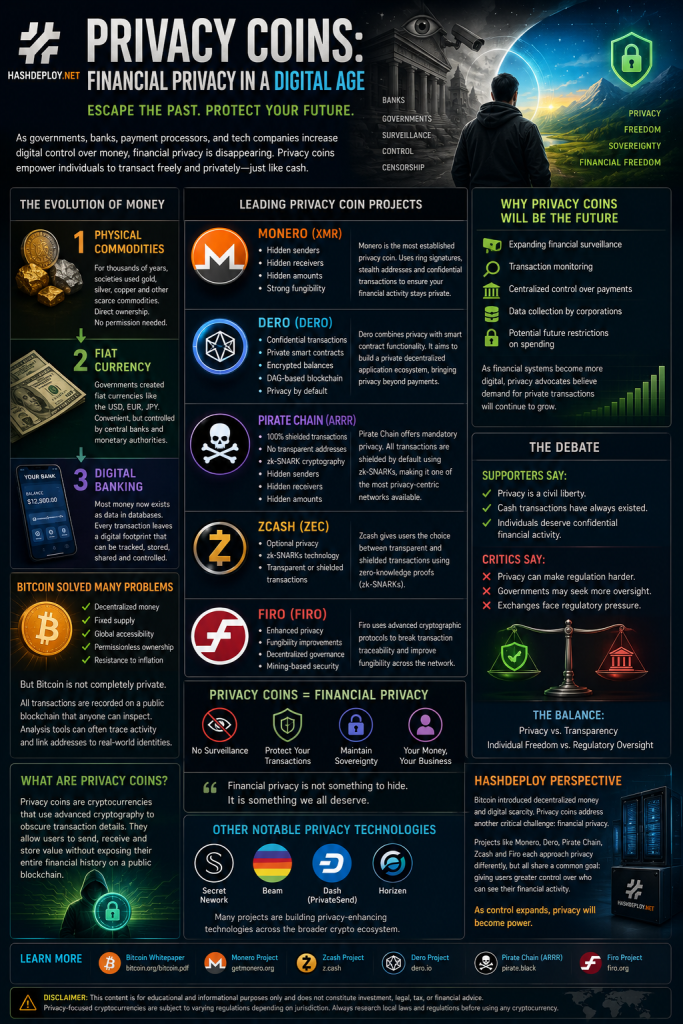
Why Privacy Matters More Than Ever
As governments, banks, payment processors, and technology companies move toward increasingly digital financial systems, many individuals are becoming concerned about the future of personal financial privacy.
Throughout history, cash transactions provided a degree of anonymity and freedom. Today, most transactions are conducted electronically, creating permanent records that can be stored, analyzed, shared, and monitored by numerous parties.
Privacy-focused cryptocurrencies, often called privacy coins, were created to address this concern by allowing individuals to transact without exposing their entire financial history to the world.
The Evolution of Money
Stage 1: Physical Commodities
For thousands of years, societies used:
- Gold
- Silver
- Copper
- Other scarce commodities
These forms of money provided direct ownership and did not require permission from a third party.
Stage 2: Fiat Currency
Modern governments eventually transitioned to fiat currencies:
- US Dollar
- Euro
- Yen
- Pound Sterling
While convenient, fiat systems rely on central banks and monetary authorities that control issuance and monetary policy.
Stage 3: Digital Banking
Today, most money exists as entries within banking databases.
Digital banking offers convenience but also creates:
- Transaction tracking
- Financial surveillance
- Account restrictions
- Payment censorship risks
- Data collection
Every transaction leaves a digital footprint.
Bitcoin Solved Many Problems
Bitcoin introduced:
✅ Decentralized money
✅ Fixed supply
✅ Global accessibility
✅ Permissionless ownership
✅ Resistance to inflationary monetary policy
However, many newcomers are surprised to learn that Bitcoin is not completely private.
Bitcoin transactions are recorded on a public blockchain that anyone can inspect.
Although identities are not directly attached to addresses, blockchain analysis companies can often trace activity under certain circumstances.
The Rise of Privacy Coins
Privacy coins were developed to improve transaction confidentiality.
Their goal is simple:
Protect Financial Privacy
Just as most people would not publish:
- Bank statements
- Paychecks
- Investment balances
- Spending habits
Privacy coin users believe financial activity should remain personal.
Leading Privacy Coin Projects
Monero (XMR)
Monero
Monero is widely considered the leading privacy-focused cryptocurrency.
Features include:
- Hidden sender information
- Hidden recipient information
- Hidden transaction amounts
- Fungibility between all coins
Monero’s privacy protections are enabled by technologies such as ring signatures, stealth addresses, and confidential transactions.
Monero (XMR)
Monero
Monero is widely considered the leading privacy-focused cryptocurrency.
Features include:
- Hidden sender information
- Hidden recipient information
- Hidden transaction amounts
- Strong fungibility
Monero utilizes ring signatures, stealth addresses, and confidential transactions to maximize on-chain privacy.
Dero (DERO)
Dero
Dero combines privacy technology with smart contract functionality.
Unlike many privacy-focused cryptocurrencies that primarily focus on payments, Dero aims to build a private decentralized application ecosystem.
Key features include:
- Confidential transactions
- Private smart contracts
- Encrypted balances
- DAG-based blockchain architecture
- Built-in privacy by default
Supporters view Dero as an attempt to bring privacy not only to payments but also to decentralized applications and business logic.
Pirate Chain (ARRR)
Pirate Chain
Pirate Chain is a cryptocurrency focused on mandatory privacy.
Unlike projects where privacy is optional, Pirate Chain requires all transactions to utilize shielded technology.
Key features include:
- 100% shielded transactions
- No transparent addresses
- zk-SNARK cryptography
- Hidden senders
- Hidden receivers
- Hidden transaction amounts
Its supporters often describe Pirate Chain as one of the most privacy-centric cryptocurrency networks currently operating.
Zcash (ZEC)
Zcash
Zcash utilizes zero-knowledge proofs known as zk-SNARKs.
Users can choose between:
- Transparent transactions
- Shielded private transactions
This flexibility allows users to balance privacy and transparency based on their needs.
Firo (FIRO)
Firo
Firo focuses on privacy and fungibility through specialized cryptographic protocols designed to break transaction traceability.
Features include:
- Enhanced transaction privacy
- Fungibility improvements
- Decentralized governance
- Mining-based security
Other Notable Privacy Technologies
While not always classified strictly as privacy coins, several projects are working on privacy-enhancing technologies across the broader cryptocurrency ecosystem:
- Secret Network
- Beam
- Dash
- Horizen
HashDeploy Perspective
Bitcoin solved digital scarcity.
Privacy-focused cryptocurrencies seek to solve another challenge: protecting financial information in an increasingly transparent digital world.
Projects such as Monero, Dero, Pirate Chain, Zcash, and Firo each approach privacy differently, but all share a common goal: giving users greater control over who can view their financial activity. As governments, corporations, and financial institutions continue expanding digital transaction systems, privacy technologies may play an increasingly important role in the broader cryptocurrency ecosystem.
Why Some Believe Privacy Coins Could Become More Important
Supporters argue that financial privacy is a fundamental human right.
Their concerns include:
- Expanding financial surveillance
- Transaction monitoring
- Centralized control over payments
- Data collection by corporations
- Potential future restrictions on spending
As financial systems become increasingly digital, privacy advocates believe demand for private transactions may increase.
The Debate
Privacy coins remain controversial.
Supporters argue:
- Privacy is a civil liberty.
- Cash transactions have always existed.
- Individuals deserve confidential financial activity.
Critics argue:
- Increased privacy can make regulatory compliance more difficult.
- Governments may seek greater oversight of financial transactions.
- Some exchanges have limited support for privacy-focused assets due to regulatory concerns.
The debate often centers on balancing:
Privacy vs. Transparency
Individual Freedom vs. Regulatory Oversight
HashDeploy Perspective
At HashDeploy, we believe every cryptocurrency serves a different purpose.
Bitcoin introduced decentralized money and digital scarcity.
Privacy-focused cryptocurrencies aim to address another challenge:
Financial Privacy
As global financial systems become increasingly digital, many users are exploring technologies that provide greater control over their financial information.
Whether privacy coins become a major part of the future financial landscape remains uncertain. However, the conversation surrounding privacy, personal sovereignty, and digital freedom is likely to remain one of the most important discussions in the cryptocurrency industry for years to come.
Learn More
- Bitcoin Whitepaper: https://bitcoin.org/bitcoin.pdf
- Monero Project: https://www.getmonero.org
- Zcash Project: https://z.cash
- Firo Project: https://firo.org
Disclaimer: This article is for educational and informational purposes only and does not constitute investment, legal, tax, or financial advice. Privacy-focused cryptocurrencies are subject to varying regulations depending on jurisdiction. Always research local laws and regulations before using any cryptocurrency.