
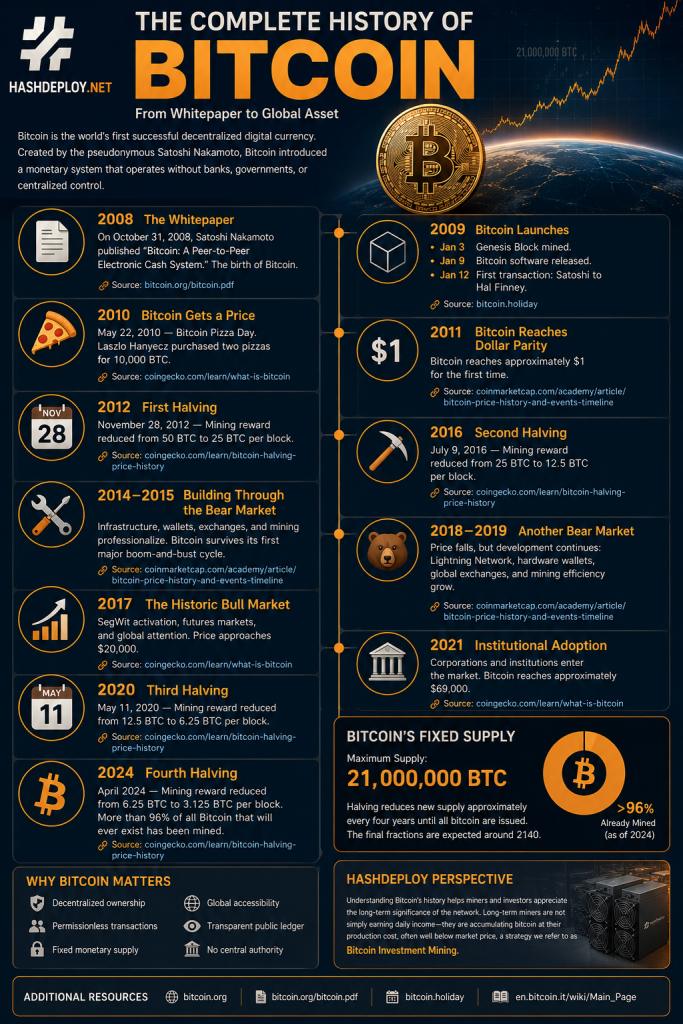
From Whitepaper to Global Asset
Bitcoin is the world’s first successful decentralized digital currency. Created by the pseudonymous Satoshi Nakamoto, Bitcoin introduced a monetary system that operates without banks, governments, or centralized control. Today, Bitcoin is recognized globally as a scarce digital asset with a fixed supply of 21 million coins. (CoinGecko)
2008: The Whitepaper
On October 31, 2008, Satoshi Nakamoto published the paper:
“Bitcoin: A Peer-to-Peer Electronic Cash System”
The whitepaper described a decentralized monetary network that would allow users to send value directly to one another without relying on trusted third parties such as banks. This publication is widely considered the birth of Bitcoin. (CoinGecko)
Source:
2009: Bitcoin Launches
January 3, 2009 — Genesis Block
Satoshi mined Block 0, known as the Genesis Block.
Embedded inside the block was the famous message:
“The Times 03/Jan/2009 Chancellor on brink of second bailout for banks”
The message referenced the ongoing financial crisis and has become one of the most iconic moments in Bitcoin history. (Investopedia)
January 9, 2009
The Bitcoin software was publicly released and the network officially began operating. Early adopters could now participate in mining and transactions. (Reddit)
January 12, 2009
The first Bitcoin transaction occurred between Satoshi Nakamoto and Hal Finney, one of Bitcoin’s earliest supporters. (bitcoin.holiday)
2010: Bitcoin Gets a Price
May 22, 2010 — Bitcoin Pizza Day
Programmer Laszlo Hanyecz purchased two pizzas for 10,000 BTC.
This is considered the first documented real-world Bitcoin purchase and established Bitcoin’s first practical market value. (CoinGecko)
Today, May 22 is celebrated annually as Bitcoin Pizza Day.
2011: Bitcoin Reaches Dollar Parity
Bitcoin reached approximately $1 for the first time.
This milestone demonstrated that Bitcoin could function as a tradable digital asset and sparked wider interest among technologists, libertarians, and investors. (CoinMarketCap)
2012: First Bitcoin Halving
November 28, 2012
Bitcoin’s first halving reduced the mining reward from:
- 50 BTC per block
- to 25 BTC per block
This event demonstrated Bitcoin’s predetermined monetary policy and fixed supply schedule. (CoinGecko)
2013: Bitcoin Goes Mainstream
Bitcoin surpassed $1,000 for the first time.
Media attention exploded and Bitcoin became known worldwide as an alternative financial system. (CoinGecko)
2014–2015: Building Through the Bear Market
After a major price decline, developers continued building infrastructure:
- Wallets improved
- Exchanges expanded
- Mining became increasingly professionalized
- Institutional interest slowly emerged
Bitcoin survived its first major boom-and-bust cycle. (CoinMarketCap)
2016: Second Halving
July 9, 2016
Mining rewards were reduced again:
- 25 BTC
- to 12.5 BTC
Bitcoin’s supply issuance continued decreasing exactly as programmed by Satoshi years earlier. (CoinGecko)
2017: The Historic Bull Market
Major milestones included:
- SegWit activation
- Growing institutional awareness
- Bitcoin futures markets launching
- Price approaching $20,000
Bitcoin became a household name worldwide. (CoinGecko)
2018–2019: Another Bear Market
Bitcoin fell dramatically from its 2017 highs.
Despite negative media coverage, development continued:
- Lightning Network growth
- Hardware wallet adoption
- Increased mining efficiency
- Expansion of global exchanges
Bitcoin demonstrated resilience once again. (CoinMarketCap)
2020: Third Halving
May 11, 2020
Block rewards were reduced:
- 12.5 BTC
- to 6.25 BTC
The event occurred amid unprecedented global monetary stimulus during the COVID era, strengthening Bitcoin’s narrative as a scarce asset. (CoinGecko)
2021: Institutional Adoption
Major corporations and investment firms entered the Bitcoin market.
Notable developments included:
- Corporate treasury adoption
- Institutional investment funds
- Increased public awareness
- Bitcoin reaching approximately $69,000
Bitcoin evolved from a niche technology into a recognized global asset. (CoinGecko)
2024: Fourth Halving
April 2024
The fourth Bitcoin halving reduced mining rewards:
- 6.25 BTC
- to 3.125 BTC
More than 96% of all Bitcoin that will ever exist had already been mined by this point. (CoinGecko)
Bitcoin’s Fixed Supply
Unlike fiat currencies that can be printed indefinitely, Bitcoin has a maximum supply of:
21,000,000 BTC
The halving mechanism reduces new supply approximately every four years until all bitcoin have been issued. The final fractions of bitcoin are expected to be mined around the year 2140. (Bitcoin Learning Academy)
Why Bitcoin Matters
Bitcoin introduced several innovations:
✅ Decentralized ownership
✅ Permissionless transactions
✅ Fixed monetary supply
✅ Global accessibility
✅ Transparent public ledger
✅ No central authority
For many supporters, Bitcoin represents the first truly scarce digital asset and an alternative to traditional monetary systems. For critics, it remains a speculative asset. Regardless of perspective, Bitcoin has become one of the most influential technological and financial innovations of the 21st century. (CoinGecko)
Additional Resources
HashDeploy Perspective
At HashDeploy, we believe understanding Bitcoin’s history helps miners and investors appreciate the long-term significance of the network. While many focus only on daily profitability, Bitcoin’s history shows a consistent pattern of decreasing issuance, increasing scarcity, and growing global recognition. Long-term miners are not simply earning daily income—they are accumulating bitcoin at their production cost, often well below market price, a strategy we refer to as Bitcoin Investment Mining.