
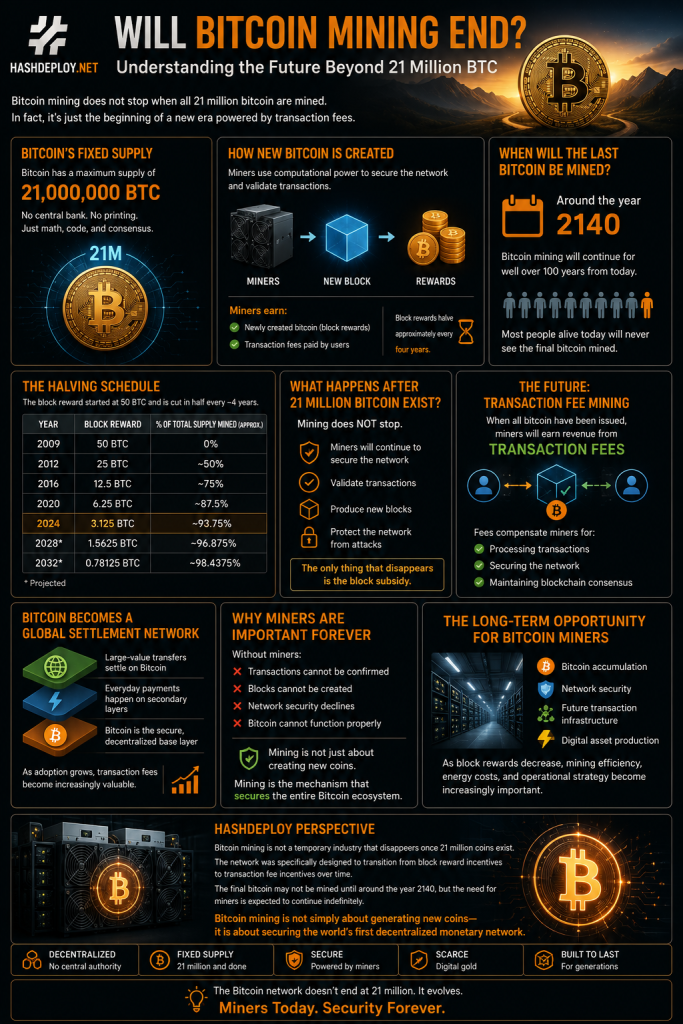
The Biggest Misunderstanding in Bitcoin Mining
One of the most common misconceptions in cryptocurrency is that Bitcoin mining will simply stop once all 21 million bitcoin have been mined.
The reality is very different.
Bitcoin mining is expected to continue long after the final bitcoin enters circulation. In fact, the Bitcoin network depends on miners to secure and process transactions indefinitely.
Bitcoin’s Fixed Supply
Bitcoin was designed by Satoshi Nakamoto with a maximum supply of:
21,000,000 BTC
Unlike traditional fiat currencies, no central bank can create additional bitcoin beyond this limit.
This fixed supply is one of Bitcoin’s most important features and is a major reason many investors consider it a scarce digital asset.
How New Bitcoin Is Created
New bitcoin enters circulation through mining.
Miners perform computational work to secure the network and validate transactions.
As a reward, miners receive:
- Newly created bitcoin (block rewards)
- Transaction fees paid by network users
Today, miners earn both.
However, the amount of newly created bitcoin decreases approximately every four years through an event known as the Bitcoin Halving.
The Halving Schedule
Bitcoin began with a reward of:
50 BTC per Block
The reward has been reduced several times:
| Year | Block Reward |
|---|---|
| 2009 | 50 BTC |
| 2012 | 25 BTC |
| 2016 | 12.5 BTC |
| 2020 | 6.25 BTC |
| 2024 | 3.125 BTC |
| 2028* | 1.5625 BTC |
| 2032* | 0.78125 BTC |
*Projected
Each halving reduces the amount of new bitcoin entering circulation.
When Will the Last Bitcoin Be Mined?
Based on Bitcoin’s mathematical design, the final fraction of a bitcoin is expected to be mined around:
Year 2140
That means Bitcoin mining is expected to continue for well over 100 years from today.
Most people alive today will never see the final bitcoin mined.
What Happens After 21 Million Bitcoin Exist?
This is where many people become confused.
Mining Does NOT Stop
Miners will continue to:
- Validate transactions
- Secure the blockchain
- Produce new blocks
- Protect the network from attacks
The only thing that disappears is the block subsidy (newly created bitcoin).
The Future: Transaction Fee Mining
When all bitcoin have been issued, miners will earn revenue from:
Transaction Fees
Every Bitcoin transaction includes a fee paid by users.
These fees compensate miners for:
- Processing transactions
- Securing the network
- Maintaining blockchain consensus
As Bitcoin adoption grows, many experts believe transaction fees could become the primary incentive for miners.
Bitcoin Becomes a Global Settlement Network
Some supporters believe Bitcoin’s future may resemble a global settlement layer.
In this scenario:
- Everyday payments may occur on secondary layers
- Large-value transfers settle on the Bitcoin blockchain
- Transaction fees become increasingly valuable
Miners would continue operating because users still need secure block production.
Why Miners Are Important Forever
Without miners:
- Transactions cannot be confirmed
- Blocks cannot be created
- Network security declines
- Bitcoin cannot function properly
Mining is not merely a method of creating new coins.
Mining is the mechanism that secures the entire Bitcoin ecosystem.
The Long-Term Opportunity for Bitcoin Miners
Many newcomers focus only on today’s mining profitability.
However, long-term miners often view mining differently.
They are participating in:
- Bitcoin accumulation
- Network security
- Future transaction infrastructure
- Digital asset production
As block rewards decrease, mining efficiency, energy costs, and operational strategy become increasingly important.
HashDeploy Perspective
Bitcoin mining is not a temporary industry that disappears once 21 million coins exist.
The network was specifically designed to transition from block reward incentives to transaction fee incentives over time.
The final bitcoin may not be mined until around the year 2140, but the need for miners is expected to continue indefinitely.
At HashDeploy, we believe understanding this distinction is critical. Bitcoin mining is not simply about generating new coins—it is about securing the world’s first decentralized monetary network. Long after the last bitcoin is issued, miners will remain an essential part of Bitcoin’s future.