Introduction
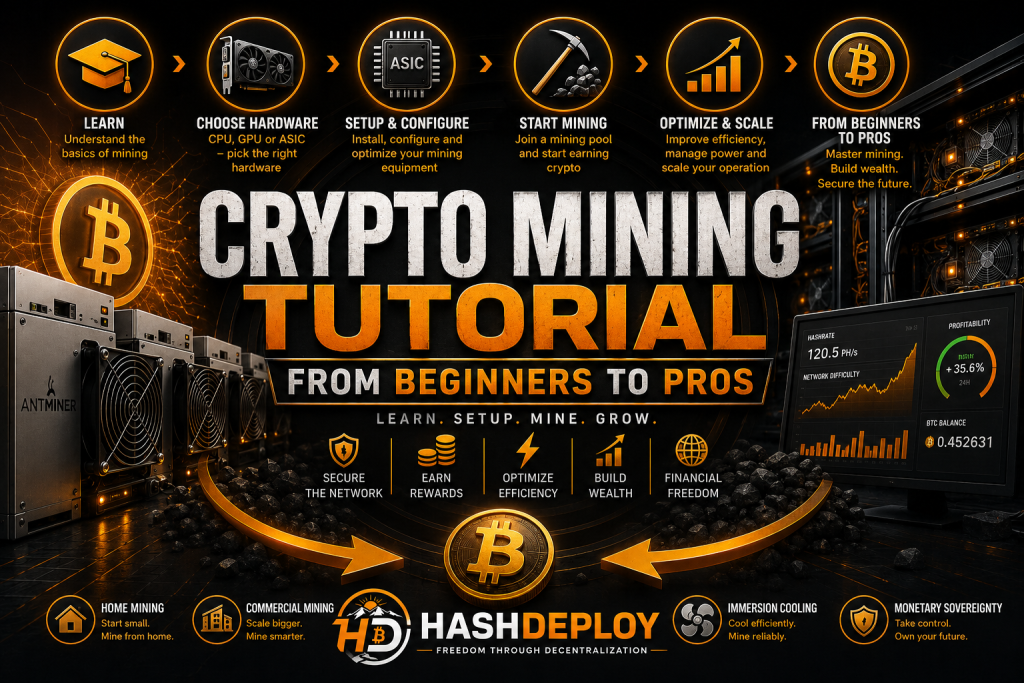
Cryptocurrency mining has evolved dramatically over the past decade. What began as a hobby on desktop computers has transformed into a global industry securing trillions of dollars in digital assets.
Many newcomers are intimidated by mining because of the technical terminology, hardware choices, and rapidly changing landscape. The reality is that anyone can learn the fundamentals and gradually progress from beginner to advanced miner.
This guide explains everything from basic concepts to professional-scale mining operations.
What Is Cryptocurrency Mining?
At its core, mining is the process of using computing power to secure a blockchain network and validate transactions.
Miners perform calculations that help maintain network consensus. In return, miners receive newly created coins and transaction fees.
Mining serves three critical functions:
- Securing the network
- Processing transactions
- Issuing new coins
Without miners, Proof-of-Work cryptocurrencies such as Bitcoin would not function.
Understanding Hashrate
Hashrate measures the computational power contributed by a miner.
Examples:
- GH/s = Gigahashes per second
- TH/s = Terahashes per second
- PH/s = Petahashes per second
- EH/s = Exahashes per second
Higher hashrate generally means a greater probability of earning mining rewards.
Modern Bitcoin mining is measured in terahashes and petahashes rather than the megahashes used in the early days.
Mining Hardware Explained
CPU Mining
The original form of mining.
Pros:
- Low startup cost
- Easy to learn
Cons:
- Low profitability for most major coins
Examples:
- Monero
- Dero
GPU Mining
Graphics cards remain popular for many alternative cryptocurrencies.
Pros:
- Flexible
- Can switch algorithms
- Strong resale value
Cons:
- Higher power consumption
- More maintenance
ASIC Mining
Application Specific Integrated Circuits are machines designed for one algorithm.
Pros:
- Extremely efficient
- Highest hashrates
Cons:
- Limited flexibility
- Higher initial cost
Examples:
- Bitmain Antminer Series
- MicroBT WhatsMiner Series
- Canaan Avalon Series
Understanding Electricity
Electricity is the largest operating expense for most miners.
Formula:
Daily Power Cost =
Power Consumption × 24 Hours × Electricity Rate
Example:
3000W miner
3kW × 24 = 72kWh per day
At $0.10/kWh:
72 × $0.10 = $7.20 daily power cost
Understanding your power rate is essential before purchasing equipment.
Home Mining vs Commercial Mining
Home Mining
Benefits:
- Complete control
- Small startup investment
- Excellent educational experience
Challenges:
- Noise
- Heat
- Electrical limitations
Popular home miners include:
- Bitaxe
- NerdAxe
- Avalon Nano
- Lucky Miner devices
Commercial Mining
Benefits:
- Lower operating costs
- Industrial-scale infrastructure
- Better economics
Challenges:
- Larger capital requirements
- Increased complexity
Commercial facilities often deploy hundreds or thousands of ASICs.
Choosing a Mining Pool
Mining pools combine the hashrate of many miners.
Benefits:
- Consistent payouts
- Reduced variance
- Easier profitability planning
Popular Bitcoin pools include:
- Foundry USA
- AntPool
- ViaBTC
- F2Pool
- Luxor
Pool selection should consider:
- Fees
- Reliability
- Payout methods
- Geographic location
Understanding Difficulty
Mining difficulty automatically adjusts to maintain block production timing.
When more miners join the network:
- Difficulty increases
When miners leave:
- Difficulty decreases
Difficulty is one of the primary factors affecting long-term profitability.
The Concept Most Beginners Miss
Daily Profit Is Not Everything
Many new miners focus entirely on daily profitability calculators.
Professional miners often think differently.
Mining can be viewed as acquiring cryptocurrency at a production cost rather than a retail market price.
Example:
If Bitcoin trades at $120,000 but your mining operation effectively acquires Bitcoin for $70,000 in electricity and equipment costs, you are obtaining exposure below market value.
This concept is sometimes referred to as “investment mining.”
The most successful miners often focus on long-term accumulation rather than short-term daily profits.
Managing Heat and Noise
Mining converts electricity into heat.
Options include:
Air Cooling
Most common.
Pros:
- Simple
- Low cost
Cons:
- Noise
- Dust accumulation
Water Cooling
Pros:
- Reduced temperatures
- Better efficiency
Cons:
- Increased complexity
Immersion Cooling
Machines are submerged in dielectric fluid.
Pros:
- Excellent cooling
- Reduced noise
- Increased hardware lifespan
Cons:
- Higher initial investment
Many professional operations now utilize immersion systems.
Advanced Topics
Firmware Optimization
Custom firmware can improve:
- Efficiency
- Stability
- Performance
Examples include:
- VNish
- Braiins OS
Always verify compatibility before installation.
Electrical Infrastructure
Professional miners understand:
- Load balancing
- Breaker sizing
- PDUs
- Transformer requirements
- Three-phase power
Proper infrastructure is critical for safe operation.
Mining Economics
Professional miners monitor:
- Network difficulty
- Hashprice
- Power costs
- Coin price
- Hardware depreciation
- Cooling costs
Mining is both a technical and financial business.
Building a Long-Term Mining Strategy
The most successful miners typically:
- Accumulate during bear markets
- Upgrade hardware strategically
- Focus on efficiency
- Control operating expenses
- Think in years, not weeks
Mining rewards patience and discipline.
Why Education Matters
Hardware is only part of the equation.
Understanding networks, economics, energy markets, and security provides a significant advantage over simply chasing the highest daily profit number.
The miners who survive multiple market cycles are usually the ones who continuously educate themselves and adapt to changing conditions.
The HashDeploy Commitment
For more than a decade, HashDeploy has helped individuals and businesses navigate the rapidly evolving mining industry.
Whether you’re setting up your first Bitaxe, expanding a home operation, deploying commercial ASIC fleets, or exploring immersion cooling solutions, our mission is to provide reliable hardware, practical guidance, and industry-leading education.
The future belongs to those who understand the infrastructure behind digital money.
Final Thoughts
Every professional miner started as a beginner.
The path from a single home miner to a large-scale operation begins with understanding the fundamentals.
Learn the technology.
Understand the economics.
Control your costs.
Think long term.
And remember: mining is not simply about generating daily profit—it is about participating directly in the networks that secure the future of digital currency.
HashDeploy — Supporting Miners Worldwide Since 2014.